
Are Bengals "jungle cats"?
Sort of! The Bengal cat breed was developed by crossing the Asian Leopard Cat with a domestic cat, creating a striking hybrid known for its exotic, leopard-like appearance. Crosses with Asian Leopard Cats produce F1 Bengals. F1 and F2 males are sterile, while females can be bred to create the next generation (F2, F3). Early generations (F1–F3) are considered hybrids and are not eligible for TICA shows. F4 Bengals are the first generation recognized as true Bengal cats, and all TICA-registered Bengals from reputable breeders are F4 or later.

Is a Bengal right for me or my family?
Bengals are not your average cat—they’re a lifestyle. They are highly active, intelligent, social, and therapeutic companions that thrive in active homes. Known for their striking rosetted, leopard-like coats, Bengals also enjoy playing fetch, walking on a leash or harness, and have an affinity for water.
Because of their high energy and intelligence, Bengals require time, commitment, and proper enrichment (such as catios, climbing spaces, interactive toys, top quality nutrition, and daily affection) to thrive in your home.
How can I tell a Bengal is a purebred and not a regular cat?
A Bengal should have distinct rosetted or marbled markings, a high-contrast coat, and a lean, athletic build. However, appearance alone does not confirm authenticity.
Reputable Bengal breeders are typically registered with The International Cat Association and can provide full pedigree documentation tracing the kitten’s lineage through previous generations. If a breeder cannot provide verifiable paperwork, the cat is likely not a purebred Bengal or is being bred irresponsibly.
Trustworthy breeders are also transparent about their program. They openly share their cattery environment, provide photos and videos, maintain reviews or references, and supply TICA registration documents for both parent cats and litters.*
Price is another important indicator. Bengals are a selectively bred, high-maintenance breed requiring extensive health testing and care, which is reflected in their cost. Unusually low-priced “Bengals” are often not purebred or come from unethical breeding practices.
Read more about "Avoiding Bengal Scams"
*We do not publicly list our cattery's registration paperwork or our Bengal's registration paperwork, as scammers will photoshop these documents and put false information. HOWEVER, we will immediately send this information to you via email or text! We are proud of our Bengals and our cattery!


glittery coat with clearly defined rosettes
dull coat with weak spots

Sample pedigree from TICA (The International Cat Association) displaying a 5 Generation ancestry for a registered feline
What are the different Bengal patterns?
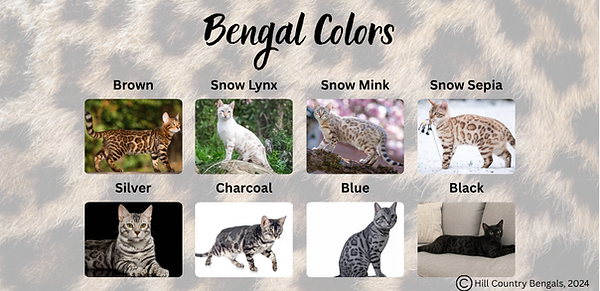
Every Bengal traces its look back to the Asian leopard cat, a small wild feline known for its rich golden coat, bold black spotting, and striking facial markings.
When Bengals were first developed, breeders aimed to preserve that wild appearance while introducing the temperament of a domestic cat. From that foundation, selective breeding expanded both color variety and pattern complexity—while keeping the exotic look intact.



Asian Leopard Cat
Prionailurus bengalensis


Bengal Cat

Why are Bengals "so expensive"?
Bengals come from a carefully managed breeding process that requires time, expertise, and investment. Responsible breeders use selective multi-generation breeding, health testing, and intensive early socialization to produce healthy, well-adjusted kittens. Demand is high for their exotic appearance and intelligent temperament. All of these factors—combined with proper care, nutrition, and ethical breeding practices—contribute to their higher cost.
If a Bengal for sale is "cheap", it is most likely not a purebred Bengal and/or comes from unethical breeding practices.
How big is a Bengal? How long can they live?
Bengals are generally about the same size as a standard, domestic housecat (about 8 lbs to 15 lbs), although some can appear larger due to their muscular build.
Bengals have a life expectancy between 12-16 years on average, although diet, lifestyle, and genetics can play a factor.

What is Bengal glitter?
Bengal glitter is a natural shimmering effect in the coat that gives the appearance of gold or pearl dust over the fur. It is most visible in good lighting on clean, healthy coats and is considered a highly desirable trait that makes Bengals appear to sparkle
Are Bengals hypoallergenic?
Bengals are considered more "allergy friendly" than other cats and dogs, however they are proven to have a lower tendency to cause allergic reactions.
Note the Bengal’s pelt, which is typically smoother, softer, and often carries a signature glittered sheen. In contrast, a domestic cat’s coat is usually more coarse and may be more prone to holding dust and allergens. We’ve also found that Bengals tend to groom themselves more efficiently and may shed less, though this can vary from cat to cat.

"Allergy friendly" Bengal pelt

Common domestic shorthair pelt

Are Bengals water cats? Do they swim?
Every cat is unique, and Bengals are no exception—their behavior can vary widely depending on personality and environment. That said, many Bengals show a natural curiosity and preference for water. We occasionally provide our Bengals with large plastic kiddie pools to see how they interact, and most enjoy pawing at the water or playing with floating toys. Every now and then, one will hop in!
While it’s not guaranteed, we’ve found that Bengals tend to be more interested in water than the average domestic cat. This may be due to their lineage, as they are descendants of the Asian leopard cat, a species known to swim and even hunt in water.
Will my Bengal walk on a leash or harness?
Yes, most Bengals can absolutely learn to walk on a leash. In fact, many of them love it. But every Bengal is different, and introducing the leash/harness in a calm manner while your Bengal is still young will often lead to the best results. However, it is not guaranteed. Because Bengals are highly intelligent and curious, they tend to enjoy the exploration and adventure.

How can I avoid kitten scams and avoid buying a "fake Bengal"?
Signs of a Purebred Bengal (Reputable Breeder):
-
Pedigree Papers Available – A legitimate breeder can provide a registered pedigree, often through organizations like The International Cat Association (TICA). Ask us- we are happy to send any from our parent cats or litters! As an FYI, we do not publicly list this on our sites, as scammers will photoshop cattery's authenticity pages and litter registrations. But we WILL email or text it to you!
-
Clear Lineage – The breeder can explain the kitten’s bloodline, including parents, generations, and history. Ask us- we can tell you where we got our parent cats, their parents, their grandparents, etc.
-
Consistent Coat Quality – True Bengals have distinct rosettes, marbling, contrast, and often a soft “glittered” coat. If you are questioning a cat's coat, it may not be a purebred Bengal!
-
Health Testing & Vet Care – Responsible breeders screen for genetic conditions and provide vet records. Our cats are routinely checked and screened.
-
Home-Raised Environment – Kittens are well-socialized, raised in-home, and exposed to people and everyday life. Check out our photos- our cats are in our home, not kennels.
-
Screening Process – Reputable breeders care where their kittens go. We interview all potential buyers to make sure our kittens go to homes where they will be properly cared for. We do not sell to anyone with the money.


Red Flags (Not a True Bengal or Unethical Seller):
-
No Paper or "Papers Cost Extra - Major Red Flag, as Bengals come with pedigreed paperwork and are easily accessible by the breeder if they are properly registering their litters with TICA (The International Cat Association). No paperwork = automatically NOT recognized as a Bengal!
-
Vague or No Lineage Info – If a breeder can't explain the parents, generations, genetics, or the cattery where they purchased their breeding cats, be cautious. It's a red flag if a breeder won't or can't tell you about their bloodlines!
-
Low Price That Seems "Too Good"/On Sale – Quality Bengals with proper care and breeding are not cheap.
-
Generic and Unimpressive Coat/Patterning– Random spots or stripes without true rosettes or structure can indicate a mixed breed.
-
Multiple Breeds/Constant Availability – Sellers offering many breeds or always having kittens available may be operating more like resellers.
-
Not Sharing Cattery Details – If a breeder won't send videos/photos of their setup or their kittens, they might be breeding unethically.
-
No Interview Process- Quick to take your money indicates a breeder does not care about their Bengals and is simply in it for the money.
-
Not Disclosing Their Location- A common scam is when fake breeders ask YOUR location first, then they are magically nearby. This is a new scam where these fake "breeders" take deposits then vanish.


Are Bengals good with kids?
Bengals can be great with kids, but it depends on the environment, the individual cat, and how the child interacts with them.
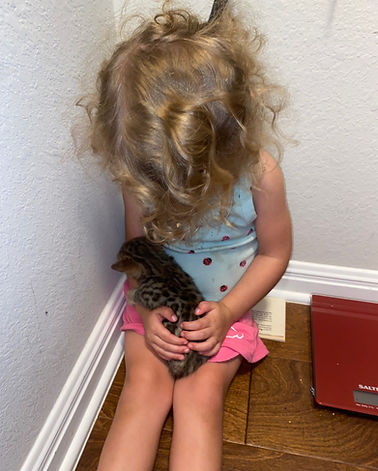
Our children socialize and take care of our Bengals in our house. We have young children who match our kitten's energy, and partake in chores like feeding them, playtime, and tending to their Bengal rooms. Our children also respect our animals, and know their boundaries!
See more photos of our children with our Bengals and as well as on
